This post is also available in:
 Español
  Nederlands
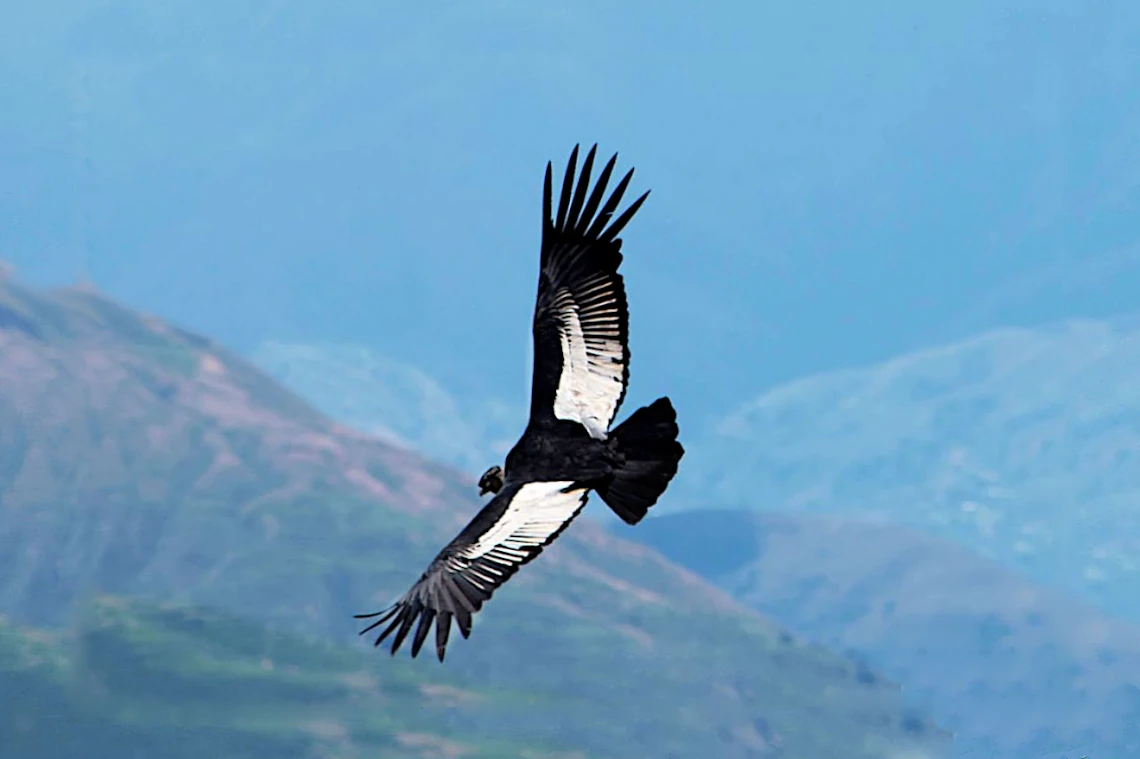
At 6,000 meters altitude, where the air weighs half as much as at sea level and a helicopter can barely stay stable, there is an animal that flies as if it were nothing. With a three-meter wingspan —the size of a Smart car— the Andean condor soars the skies without flapping its wings. And it does so for hours.
But let’s start at the beginning. Have you ever looked up at the sky in Cusco or the Colca Canyon and seen that black dot moving in circles, ever higher, with no apparent effort? The condor doesn’t fly. It soars. And that difference changes everything.
Three Meters of Pure Natural Engineering
The Andean condor (Vultur gryphus) has the largest wingspan of any land bird. Only the wandering albatross surpasses it, but the albatross lives over the sea, uses ocean winds, and needs to land on water. The condor, by contrast, operates over mountains, deserts, and Andean valleys. It is an airplane designed for extreme terrain.
Its weight: between 11 and 15 kilos. To hold 15 kilos in the air with a three-meter wingspan, nature has had to make very precise calculations. Too heavy and it won’t stay aloft. Too light and the wind loses control. The balance is almost mathematical.
The Secret of the Separated Feathers
When you see a condor in flight from below, the tips of its wings look like open fingers. Those are the primary feathers, the longest ones, and they separate creating gaps between them. This is not a flaw. It’s its most advanced lift system.
Each feather works as an independent aileron that breaks turbulence. In modern aircraft, slats and flaps serve a similar function, but they only activate during takeoff and landing. The condor uses them all the time, with no fuel consumption, no maintenance, no noise.
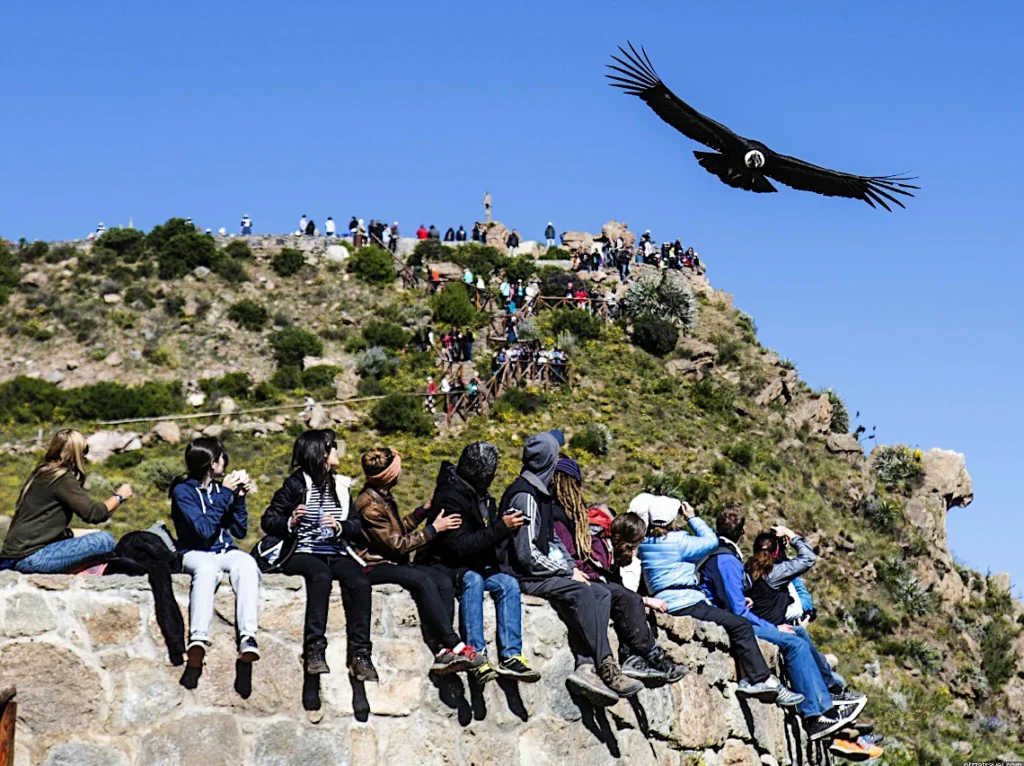
A study from the University of Alberta (Canada) published in 2020 showed that feather separation reduces aerodynamic drag by up to 40% during soaring. Aeronautical engineers are studying this design to improve the efficiency of fixed-wing drones.
Flying Without Expending Energy: The Thermal Technique
Imagine you’re in the Colca at 7 in the morning. The sun begins to warm the canyon walls. The cold night air starts to move. As the sun heats the rocks, the air rises forming invisible columns. Condors detect them with a precision that we humans still don’t fully understand.
A condor can find a thermal 5 kilometers away. It positions itself in the center of the warm air column and begins to rise in a spiral, without moving a single muscle. When it reaches the desired altitude, it glides to the next thermal. It’s like an airplane finding invisible gas stations in the sky.
With this technique, a condor can travel between 200 and 250 kilometers in a single day. Without eating, without drinking, without landing. Just soaring, harnessing the energy of the sun.
And here comes the fact that amazed me most when I first read it: according to a GPS study published in Proceedings of the National Academy of Sciences (PNAS) in 2020, condors spend less than 2% of their flight time flapping their wings. The remaining 98% they spend soaring. That means in a 5-hour flight, they flap their wings for barely 6 minutes.
Hollow Bones and Wing Loading
A condor’s skeleton weighs less than its feathers. Its bones are hollow, like those of all flying birds, but the condor’s are specially adapted to withstand the stresses of high-speed soaring. Its wing loading —the ratio between the bird’s weight and its wing area— is approximately 8 kg/m².
To put it in context:
- Andean condor: 8 kg/m² — born glider, maximum efficiency at low speed.
- Wandering albatross: 10 kg/m² — heavier wings, designed for strong winds.
- Hummingbird: 2.5 kg/m² — needs small wings for extreme maneuverability.
- Boeing 747 at takeoff: approximately 650 kg/m² — yes, we need enormous engines.
The condor is at nature’s sweet spot: wing loading low enough to soar with little wind, but high enough not to be swept away by currents.
The Condor’s Olfactory Superpower
A curiosity not many know: condors, like all New World vultures, have an opening in their beak called a naricera. Unlike most birds, they can smell. They use this sense to locate carrion under the forest canopy or in deep ravines. Old World vultures, by contrast, rely almost exclusively on sight.
This gives them an important evolutionary advantage in the Andes, where rugged terrain and vegetation can hide food even from the air.
A Design That Inspires Today’s Technology
Engineers are obsessed with the condor. In 2022, a team from the Department of Mechanical Engineering at the University of California (Berkeley) published a study showing that the curvature of the condor’s wing changes dynamically according to wind speed. Its wings are not rigid: they adapt in real time.
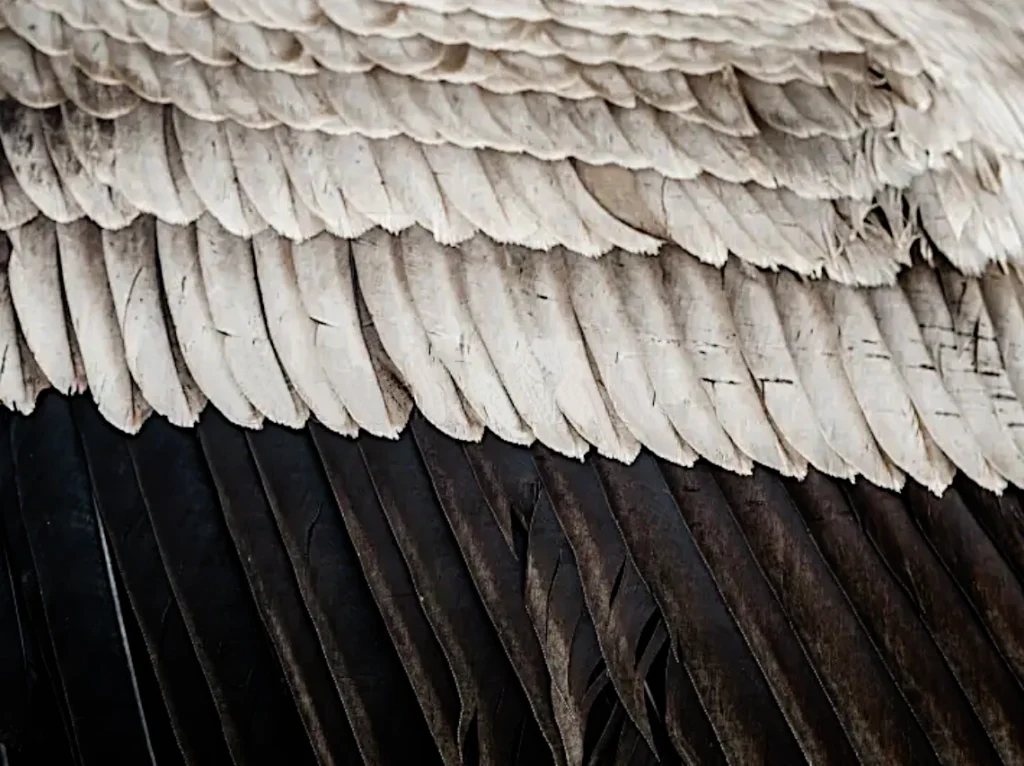
This discovery is being applied in the development of next-generation drones with ‘morphological wings,’ capable of changing shape during flight to optimize energy efficiency. Companies like Airbus have funded biomimicry studies of the condor to design future hybrid aircraft.
The Condor in Peruvian Culture
But the condor is not just a marvel of natural engineering. For Peruvians, it is a symbol. It has been on the National Coat of Arms since 1825, representing freedom and sovereignty. In the Andean worldview, the condor is the messenger of the gods, connecting the earthly world with the celestial. In the indigenous trilogy —the condor, the puma, and the serpent— the condor represents the upper world, the Hanan Pacha.
The condor dance, Waylarsh, is one of the most important folkloric expressions of Peru’s central highlands. And every year, in Yura (Arequipa), the Señalacuy ceremony is celebrated, where young condors are tagged for study and protection.
A Vulnerable Species in Need of Protection
Despite its grandeur, the Andean condor is classified as Vulnerable on the IUCN Red List. It is estimated that fewer than 10,000 individuals remain across its entire range, from Venezuela to Patagonia. The main threats are habitat loss, poisoning from contaminated carrion, and poaching.
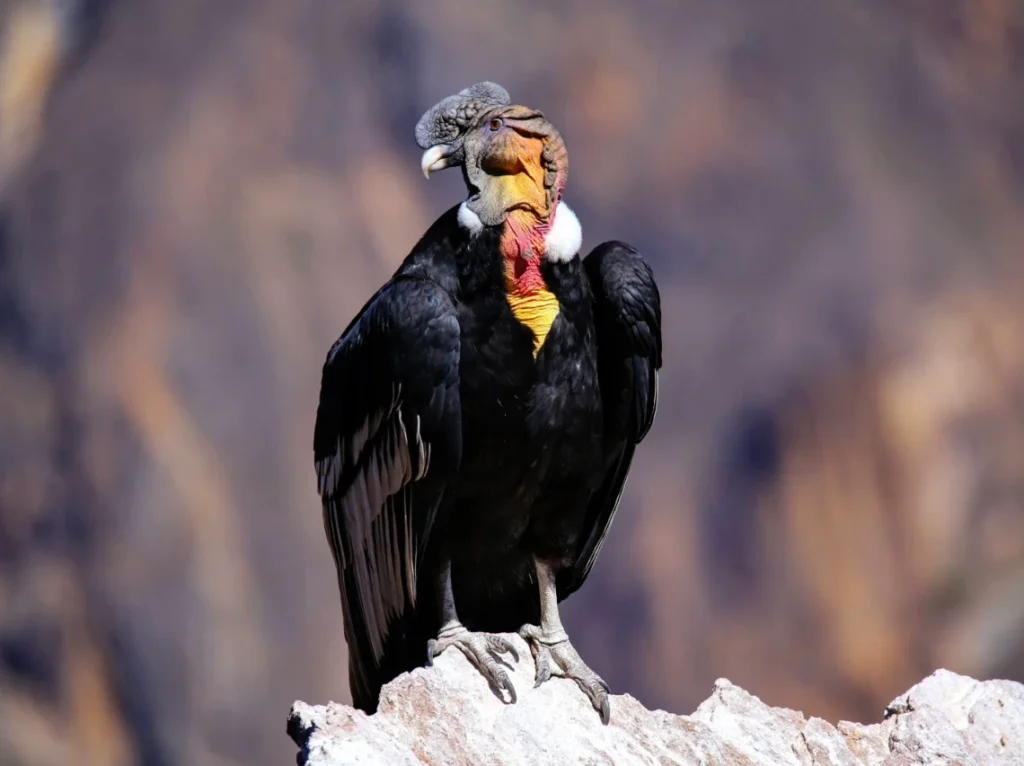
In Peru, organizations like the Asociación de Conservación del Cóndor Andino (ACCA) work on monitoring and education programs. Responsible tourism, when done right, also helps: communities that protect condors benefit from birdwatching, one of the fastest-growing segments of nature tourism in the world.
Next Time You Look at the Sky
Now, when you see the silhouette of a condor circling up there, you’ll know what it’s really doing. It’s not just flying. It’s reading the air, calculating distances, choosing thermals. It’s using an aerodynamic system that nature took millions of years to perfect and that human science is only beginning to understand.
And while you watch from below, it’s already thinking about its next thermal, 50 kilometers away.
Did you enjoy this? Share this article with someone who loves nature and help more people discover the richness of the Andes. Leave us a comment below: what other Andean animal would you like us to explore in depth?
Follow us on social media for more content about Peru’s biodiversity and culture. Every article you share helps keep this window into the Andean world alive. 🦅